

Sometimes the unfamiliar keeps us awake. Sometimes it's exactly what we needed.
There are two kinds of first nights in a hotel.
The first goes something like this:
What is that humming?
Why is there light coming from under the door?
Was that the elevator?
Why is the air conditioner turning on every eleven minutes?
And what the hell was that noise?
Then there is the other kind.
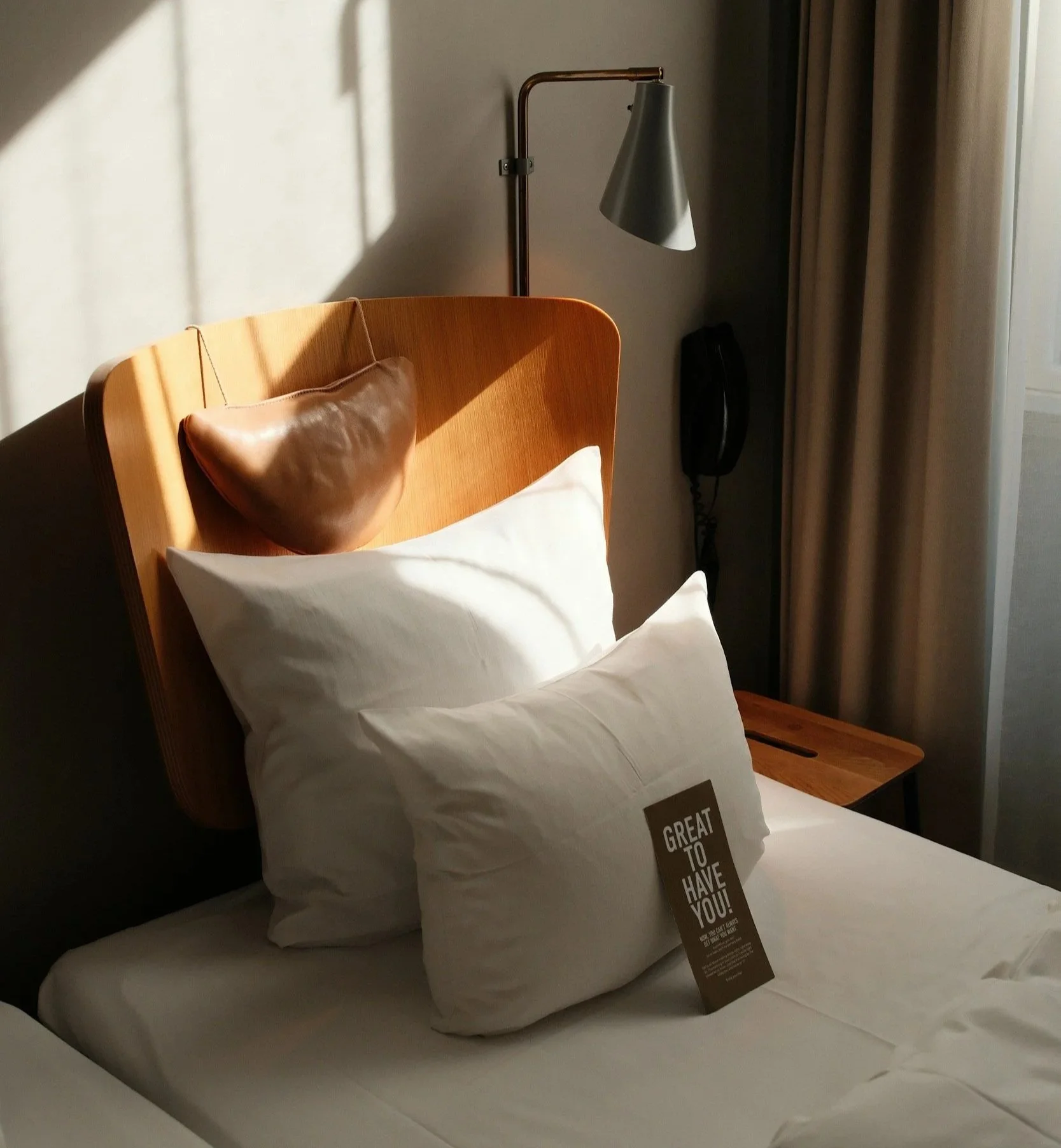
You climb into an enormous bed.
The sheets are crisp.
The room is cold.
The curtains make it completely dark.
There is nothing you need to clean, finish, organize or deal with.
And eight hours later you wake up wondering why you can't sleep like this at home.
Same basic situation. You're sleeping somewhere that isn't yours.
So why can an unfamiliar room leave us hyperaware one night and completely unconscious the next?
Your brain knows your bedroom better than you do
Spend enough time somewhere and you stop noticing much of it.
The hum of your refrigerator. Traffic outside. Your heating system turning on. The streetlight that sneaks through the edge of the curtain. The tiny glow from the charger beside your bed. Your partner breathing. The pipes. The neighbour who apparently drops a bowling ball every night at 11:17PM.
They're still there.
You've just become accustomed to them.
Our brains are constantly deciding which sensory information deserves our attention and which can fade into the background.
Familiar environments contain an enormous amount of information we've already encountered.
A hotel room doesn't.
Suddenly, the air conditioner has a different hum, the sheets smell different, the room has unfamiliar shadows.
Even silence can sound strange when it isn't your silence.
You haven't necessarily become more sensitive.
The environment has simply stopped being predictable.
There is actually a name for this
Sleep researchers call it the first-night effect.
People participating in sleep studies sometimes sleep differently during their first night in a laboratory, which is one reason researchers may use an adaptation night before collecting experimental sleep data. One particularly fascinating study found that part of the sleeping brain appeared to be paying closer attention to the unfamiliar sounds during the first night in an unfamiliar environment, almost like a neurological night watch.
This doesn’t mean half your brain literally stays awake every time you check into a hotel, but research suggests the mechanisms behind the first-night effect are part of a larger phenomenon that is well established:
Our sleep can change when the environment changes.
Which makes evolutionary sense. Sleeping is an extraordinarily vulnerable thing to do.
If you've never slept somewhere before, knowing whether the sound outside the door is normal or worth waking up for is useful information.
The second night? Now you've heard the elevator. You know what the air conditioner sounds like.
Nobody murdered you.
Carry on.
Except sometimes the hotel is the escape
Here's where the first-night effect doesn't tell the whole story. Because plenty of people sleep beautifully in hotels. Sometimes better than they do at home, and perhaps that's because the hotel hasn't only changed the bedroom. It has changed everything surrounding it.
There is no laundry pile in the corner.
No work desk staring at you.
No dishwasher you should probably empty.
No unfinished project sitting exactly where you left it.
You aren't looking around at your own responsibilities.
If you're travelling for pleasure, tomorrow may not contain your normal responsibilities either.
Breakfast might be downstairs.
Someone else is washing the sheets.
Someone else is making the bed.
For once, you are simply occupying the room.
And then there is the bed itself.
Hotels have very good reason to care about sleep.
Comfortable mattresses, layered bedding, pillow options, blackout curtains, temperature control and acoustic design aren't incidental details when the primary purpose of the room is to give someone somewhere to sleep.
At home, your bedroom may also be your laundry room, office, storage room, television room and place where you remember everything you forgot to do.
A good hotel room has one extraordinary luxury:
It asks very little of you.
Sometimes unfamiliarity creates vigilance.
Sometimes it creates distance from the life that was keeping you awake.
For the excessive hotel sleeper
If you travel constantly for work, unfamiliarity stops being occasional.
New city.
New room.
New mattress.
New sounds.
Over and over again.
In that case, it might be worth travelling with a few things that stay the same.
Your pillowcase. Your usual sleepwear. The sound you fall asleep to at home. A familiar scent. Your eye mask. Your robe.
Not a travel sleep kit.
Just a few sensory constants.
Perhaps the trick isn't making every hotel room feel like home.
It's knowing which parts of home are worth bringing with you, and which parts you're very happy to leave behind.
-DAWN MELODY
Sleep Architect + Founder, Sleep State of Mind
RESEARCH + FURTHER READING
Agnew, H. W., Webb, W. B., & Williams, R. L. (1966).
The first night effect: An EEG study of sleep. Psychophysiology, 2(3), 263–266.Tamaki, M., Bang, J. W., Watanabe, T., & Sasaki, Y. (2016).
Night Watch in One Brain Hemisphere during Sleep Associated with the First-Night Effect in Humans. Current Biology, 26(9), 1190–1194.Lehmann et al. (2024).
The first-night effect of sleep occurs over nonconsecutive nights in unfamiliar and familiar environments. Sleep.
LIMINAL
THE SPACE BETWEEN AWAKE AND ASLEEP
