
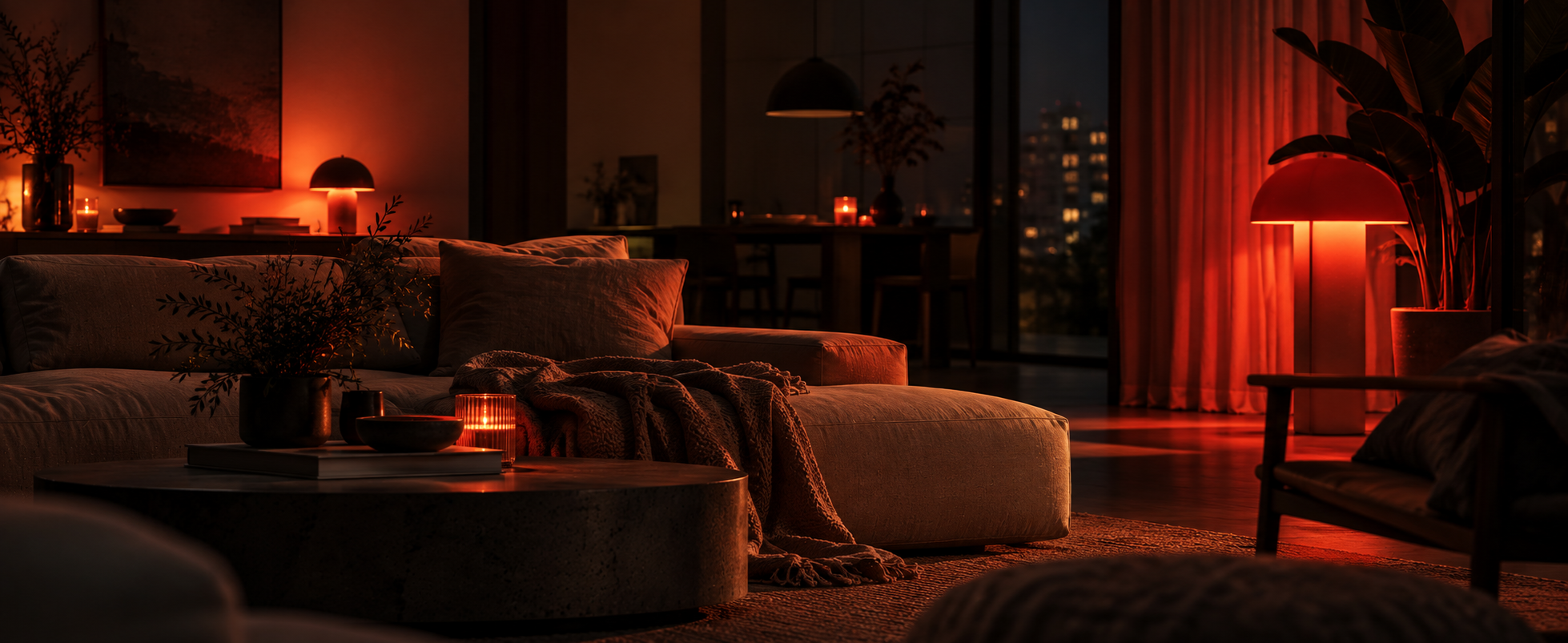
Our homes know how to be bright. They don't always know how to become night.
It's 9PM.
Outside, it is unmistakably night.
Inside? The kitchen is blazing. The bathroom could perform minor surgery. Every overhead light is on. The television is glowing. Your laptop is open. Apparently, it is noon.
We've become incredibly good at lighting our homes so we can see. I'm not sure we've become particularly good at lighting them for the time, because your home at 9PM probably looks remarkably similar to your home at 2PM.
And biologically, those are not the same time.
Our homes don't know what time it is
Light does much more than illuminate a room.
It is one of the strongest environmental signals our circadian system uses to understand time. The timing, intensity and spectrum of the light we're exposed to can influence alertness, melatonin and our internal biological clock.
For most of human history, light changed dramatically as the day progressed.
Morning looked different from midday.
Midday looked different from sunset.
And sunset looked very different from night.
Then we invented a switch, and suddenly, darkness became optional.
That's obviously been an extraordinary improvement to human life. I am not suggesting we all return to stumbling around our homes by candlelight.
But somewhere along the way, we became very good at recreating daytime after dark.
And I wonder if we've underestimated what we lost when our environments stopped changing with the time of day.
This year, B.C. stopped changing the clock
Here in British Columbia, Canada, we're about to experience something we've never experienced before.
This November, most of the province won't “fall back.” The March 2026 time change was our last seasonal clock change, which means we're now staying on the same time year-round.
And I'm curious what that's going to feel like.
Because changing the clock was always a strange artificial marker of the season.
One weekend, we'd wake up and suddenly evening seemed to arrive an hour earlier.
That abrupt shift is gone. But winter isn't.
The days will still get shorter. Darkness will still arrive earlier. Our relationship with light will still change dramatically over the next few months.
The clock just isn't going to announce it anymore.
Which makes me wonder:
If we're no longer changing our clocks with the season, maybe we should pay more attention to how our homes change with it.
Welcome to My Red Light Era
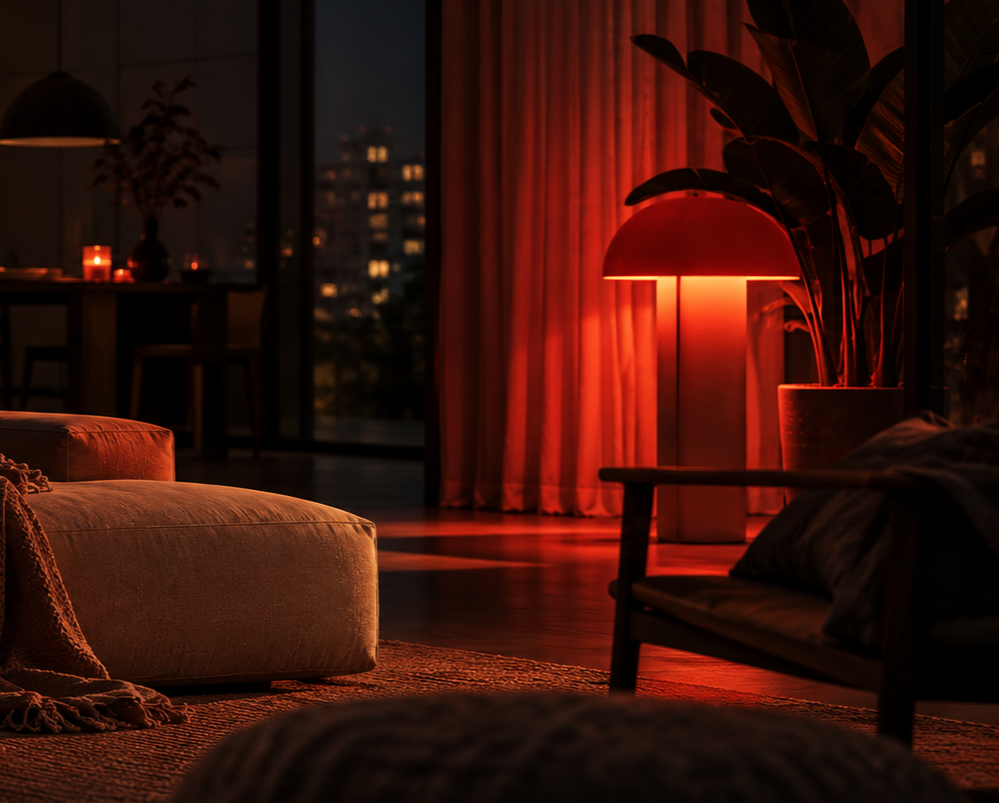
By the time I'm properly winding down, my home starts looking suspiciously like the Red Light District. Literally.
I use red light in the evening. Not because red light is some magical portal to perfect sleep, but because dimmer, warmer, longer-wavelength light is generally far less stimulating to the circadian system than the bright, cooler light we surround ourselves with during the day.
It also creates an unmistakable environmental shift. The day is changing.
Does my home occasionally look like I'm running a very different kind of business? Absolutely.
But perhaps Amsterdam was onto something.
And you certainly don't need to turn your living room red to create the same idea.
Maybe the overhead lights go off after dinner.
Maybe the lamps come on at 8PM.
Maybe the kitchen gets dimmer once you're finished using it.
Maybe the bathroom doesn't need to illuminate every pore you've ever had at 10:30PM.
The point isn't really red light.
It's transition.
Let the house become night
We tend to think about lighting as binary.
Click On.
Click Off.
But evening isn't binary.
It's a slow transition between two states.
Outside, the world already understands this. The light changes. The colour changes. The shadows change. Eventually, darkness arrives.
So why shouldn't our homes mirror that transition too?
Your home doesn't need to look like a candlelit wellness retreat every night.
It simply needs to acknowledge…
9 PM isn't 2 PM.
- DAWN MELODY
Sleep Architect + Founder, Sleep State of Mind
RESEARCH + FURTHER READING
Gooley, J. J., et al. (2011).
Exposure to room light before bedtime suppresses melatonin onset and shortens melatonin duration in humans. Journal of Clinical Endocrinology & Metabolism, 96(3), E463–E472.Santhi, N., et al. (2012).
The spectral composition of evening light and individual differences in the suppression of melatonin and delay of sleep in humans. Journal of Pineal Research, 53(1), 47–59.International Commission on Illumination (CIE). (2024).
Recommending Proper Light at the Proper Time — 3rd Edition.
LIMINAL
THE SPACE BETWEEN AWAKE AND ASLEEP
