
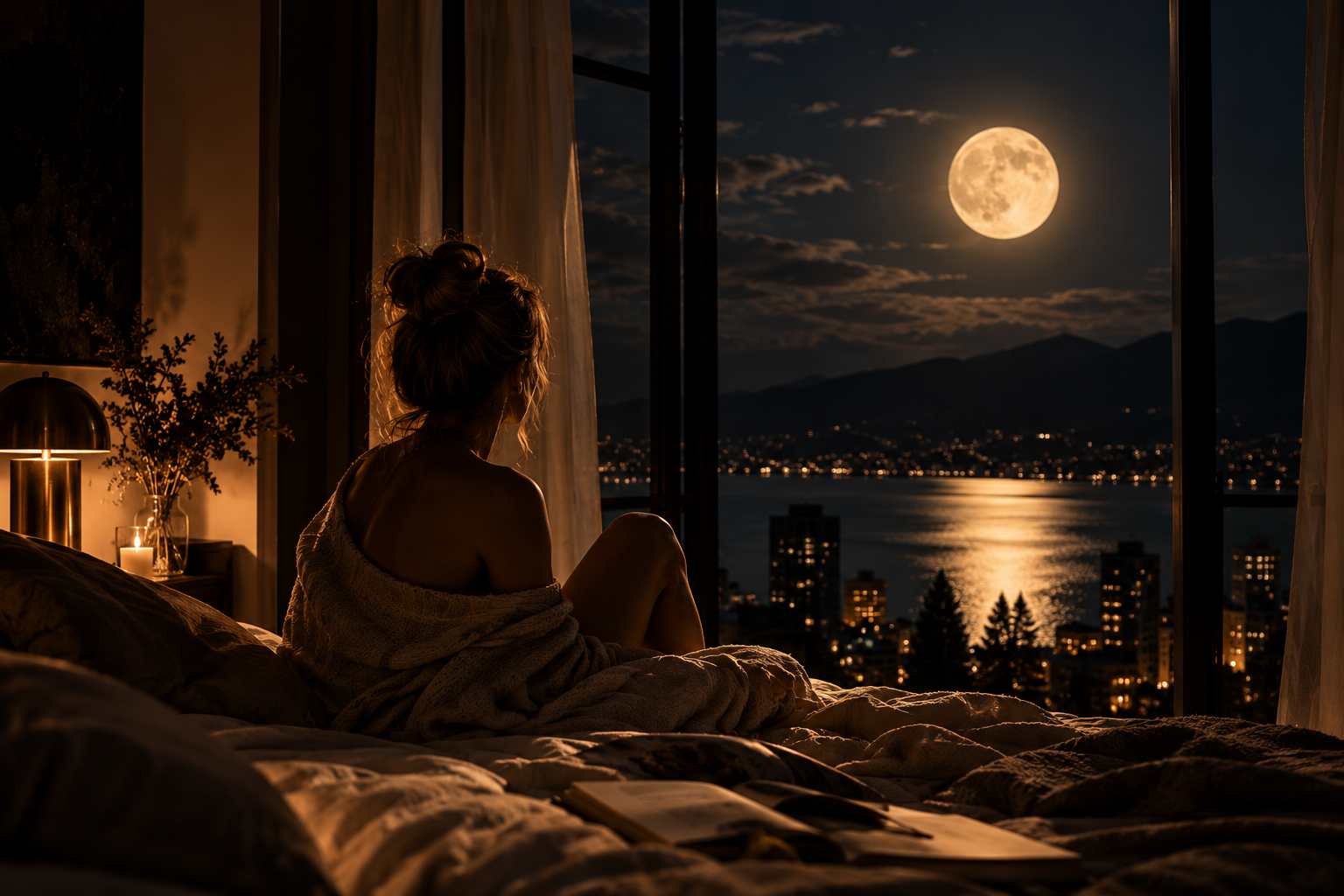
What if sleeping badly under a full moon isn't entirely in your head?
There are nights when sleep just feels different.
You get into bed at the usual time. Nothing particularly dramatic has happened. The room is dark. You're tired enough.
And yet something feels... off.
You're restless. More alert than you should be. Your dreams are strange. Maybe you wake up at 3AM for absolutely no good reason.
Eventually, someone says it.
It's a full moon.
There is something deeply satisfying about blaming the Moon.
It's ancient, slightly witchy and considerably more interesting than admitting you had coffee too late.
For thousands of years, humans have attached strange things to that glowing object in the sky. Madness. Fertility. Menstruation. Birth. Crime. Transformation. Ritual. Werewolves, obviously.
Even the word lunatic comes from luna.
The Moon has been getting blamed for things for a very long time.
Sleep, however, presents a particularly interesting question.
Because when scientists actually went looking, the Moon didn't disappear from the story quite as neatly as you might expect.
Apparently, the Moon has entered the sleep lab
In 2013, researchers in Switzerland did something interesting. They went back through data from an earlier sleep study and compared what had happened in the laboratory with the lunar cycle.
This wasn't a group of people sleeping underneath enormous bedroom windows while a full moon blasted them in the face. They were sleeping under highly controlled laboratory conditions.
More importantly, neither the participants nor the researchers had been thinking about the Moon when the original data were collected.
And yet around the full moon, something changed.
Participants took approximately five minutes longer to fall asleep. They slept around twenty minutes less. Brain activity associated with deep sleep decreased by about 30 percent. They reported poorer sleep and researchers also measured lower melatonin levels.
Which is precisely the sort of study that makes every witch on the internet whisper: I knew it!
Unfortunately for the witches, science requires replication. And things got messy.
Other researchers found associations between the lunar cycle and sleep, including poorer sleep efficiency and less deep sleep around the full moon. Others found very little.
So science has arrived at the deeply unsatisfying conclusion:
It's complicated.
Which, personally, makes the whole thing more interesting.
Before electricity, a full moon was a very different event
I think we've forgotten how dramatic moonlight once was.
Today, the Moon has competition.
Streetlights. Headlights. Televisions. Bathroom LEDs. Kitchen pendants. City glow. And the tiny illuminated rectangle approximately six inches from our face.
For most of human history, nighttime was actually dark.
Then, every lunar month, the night changed.
Around the full moon, there was suddenly enough light after sunset to see more, move around more and remain active longer.
And researchers have actually observed something remarkably similar.
A 2021 study followed people living in Indigenous Toba/Qom communities in Argentina (some with electricity and some without) as well as people living in highly urbanized Seattle.
Across these very different environments, sleep tended to begin later and last for less time on nights leading up to the full moon, when moonlight is available during the hours after dusk. The researchers proposed that artificial light may now mimic some of the effect that early-evening moonlight once had on human activity.
Suddenly the folklore doesn't sound quite so ridiculous.
Perhaps our ancestors weren't lying beneath the full moon thinking about their melatonin secretion.
But they certainly noticed that some nights were brighter than others.
And their behaviour changed accordingly.
Then it gets a little witchier
For years, one of the more seductive theories has been that the Moon might influence us through forces we can't see.
Energy.
Magnetism.
Gravity.
Earth's magnetic field is real. Geomagnetic activity is real. The Moon's gravitational pull is obviously real; ask the ocean.
But this is where we have to be careful not to turn something mysterious into something scientifically magical simply because it sounds good.
The full moon is not causing Earth's magnetic poles to shift every month, and the fact that geomagnetic activity can fluctuate does not mean lunar magnetism is secretly pulling you out of REM sleep.
The magnetic explanation for full-moon insomnia remains speculative. Gravity, however, has recently made the story considerably more interesting.
A 2026 study examining humans and non-human primates reported that sleep timing appeared to synchronize with repeating variations in lunar and solar gravitational forces. Intriguingly, the effect wasn't simply about the full moon: sleep onset shifted around periods of maximum gravitational variation, which can occur around both full and new moons. The researchers argue that lunar gravity, or another geophysical signal moving alongside it, may act as an environmental cue for sleep timing.
That's one study.
It does not mean we've discovered that the Moon's gravity is dragging you awake at 2 AM, but it does mean the conversation is no longer limited entirely to moonlight.
Which is deliciously inconvenient.
But what about energy?
Here's where I'm willing to let LIMINAL wander barefoot into the woods for a minute.
Not everything humans describe as energy is energy in the physics sense; sometimes we're describing:
Atmosphere.
Attention.
Anticipation.
A feeling in a room.
That strange electricity before a storm.
The difference between walking through your neighbourhood at noon and walking through exactly the same streets at midnight.
The physical environment may be identical.
The experience isn't.
A full moon is an event. The night looks different. Shadows become sharper. The sky becomes brighter. The Moon itself becomes almost impossible not to notice. And if you're someone who follows lunar cycles, you've added another layer entirely.
You know it's full. You expect something from it.
Humans respond to expectation and meaning too.
That doesn't make the experience imaginary.
It just makes it harder to separate the thing happening outside us from the story happening inside us.
We have always looked up
There is something else I don't want science to completely sanitize out of this conversation.
The Moon has been part of human timekeeping for an extraordinarily long time.
Before calendars lived in our phones, there was the sky.
The Moon changed predictably.
It disappeared.
Returned.
Grew.
Became full.
Faded again.
People planted by it. Travelled beneath it. Built calendars around it. Created rituals around it. Told stories about it.
And yes, slept beneath it.
Our relationship with the Moon predates the bedroom. Predates the mattress. Predates the electric light that now makes most nights look remarkably similar to one another.
There is something almost arrogant about assuming that because modern life has made the Moon less relevant to our schedules, it must have become irrelevant to our bodies too.
Science hasn't established that it controls our sleep. But it hasn't completely closed the case either.
Researchers themselves have described the evidence as conflicting and the question as still open.
Perhaps we don't have to choose
We've developed a strange habit of demanding that experiences belong entirely to one world.
Science or folklore.
Biology or ritual.
Evidence or intuition.
But humans have always lived somewhere between them.
Our ancestors noticed patterns long before they understood mechanisms.
Sometimes they were completely wrong.
Sometimes the thing they noticed was real and the explanation wasn't.
And occasionally science arrives hundreds or thousands of years later and says:
Well... that's interesting.
So if you sleep terribly during the next full moon, you don't necessarily need to cleanse your bedroom with sage.
You also don't need to roll your eyes at yourself.
Open the curtains.
Look outside.
There is something enormous and ancient lighting up the night.
Perhaps the light is affecting you.
Perhaps some quieter biological rhythm is involved.
Perhaps you noticed the Moon and expected to feel different.
Perhaps you drank coffee at 4PM and would simply prefer a more celestial explanation.
Or perhaps humans have been asking the same question beneath the same Moon for thousands of years.
I rather like that we still don't completely know.
-DAWN MELODY
Sleep Architect + Founder, Sleep State of Mind
RESEARCH + FURTHER READING
Cajochen C, Altanay-Ekici S, Münch M, Frey S, Knoblauch V, Wirz-Justice A. Evidence that the lunar cycle influences human sleep. Curr Biol. 2013 Aug 5;23(15):1485-8. doi: 10.1016/j.cub.2013.06.029. Epub 2013 Jul 25. PMID: 23891110.
Evidence that the lunar cycle influences human sleep.Turányi CZ, Rónai KZ, Zoller R, Véber O, Czira ME, Újszászi Á, László G, Szentkirályi A, Dunai A, Lindner A, Szőcs JL, Becze Á, Kelemen A, Lendvai Z, Molnar MZ, Mucsi I, Novák M. Association between lunar phase and sleep characteristics. Sleep Med. 2014 Nov;15(11):1411-6. doi: 10.1016/j.sleep.2014.06.020. Epub 2014 Aug 20. PMID: 25266502.
Association between lunar phase and sleep characteristics.Haba-Rubio J, Marques-Vidal P, Tobback N, Andries D, Preisig M, Kuehner C, Vollenweider P, Waeber G, Luca G, Tafti M, Heinzer R. Bad sleep? Don't blame the moon! A population-based study. Sleep Med. 2015 Nov;16(11):1321-1326. doi: 10.1016/j.sleep.2015.08.002. Epub 2015 Aug 18. PMID: 26498230.
Bad sleep? Don't blame the moon! A population-based studyCasiraghi L, Spiousas I, Dunster GP, McGlothlen K, Fernández-Duque E, Valeggia C, de la Iglesia HO. Moonstruck sleep: Synchronization of human sleep with the moon cycle under field conditions. Sci Adv. 2021 Jan 27;7(5):eabe0465. doi: 10.1126/sciadv.abe0465. PMID: 33571126; PMCID: PMC7840136.
Moonstruck sleep: Synchronization of human sleep with the moon cycle under field conditions.Ferrante GR, Casiraghi L, Spiousas I, Trebucq L, Klei V, Kahn JW, Rice A, Wood D, Fernández-Duque E, Bales KL, Gallep CM, Golombek DA, de la Iglesia HO. Lunar gravity predicts sleep timing. bioRxiv [Preprint]. 2026 Jan 29:2026.01.27.701907. doi: 10.64898/2026.01.27.701907. PMID: 41659491; PMCID: PMC12873792.
Lunar gravity predicts sleep timing.
LIMINAL
THE SPACE BETWEEN AWAKE AND ASLEEP
